· 7 min read
Google’s December Core Update Is Coming: What UK Small Businesses Should Do Now
Google finished its November core update on 24 November and has already announced another for December. Here is what changed, why the UK regulator is involved, and what small businesses should do before it lands.

Google finished its November 2026 core update on 24 November, and about an hour later it told site owners another one is coming in December. If your enquiries or online sales shifted over the last fortnight, this is probably why. And if things looked fine, there is a second round on the way before Christmas.
Here is what happened, what is different this time (Google now gives advance warning, partly because of a UK regulator), and what a small business owner should actually do about it.
What happened in November
A core update is a broad change to how Google ranks search results. It does not target any particular site or industry. Google runs several a year, and each one reshuffles rankings as its systems reassess which pages best answer a search.
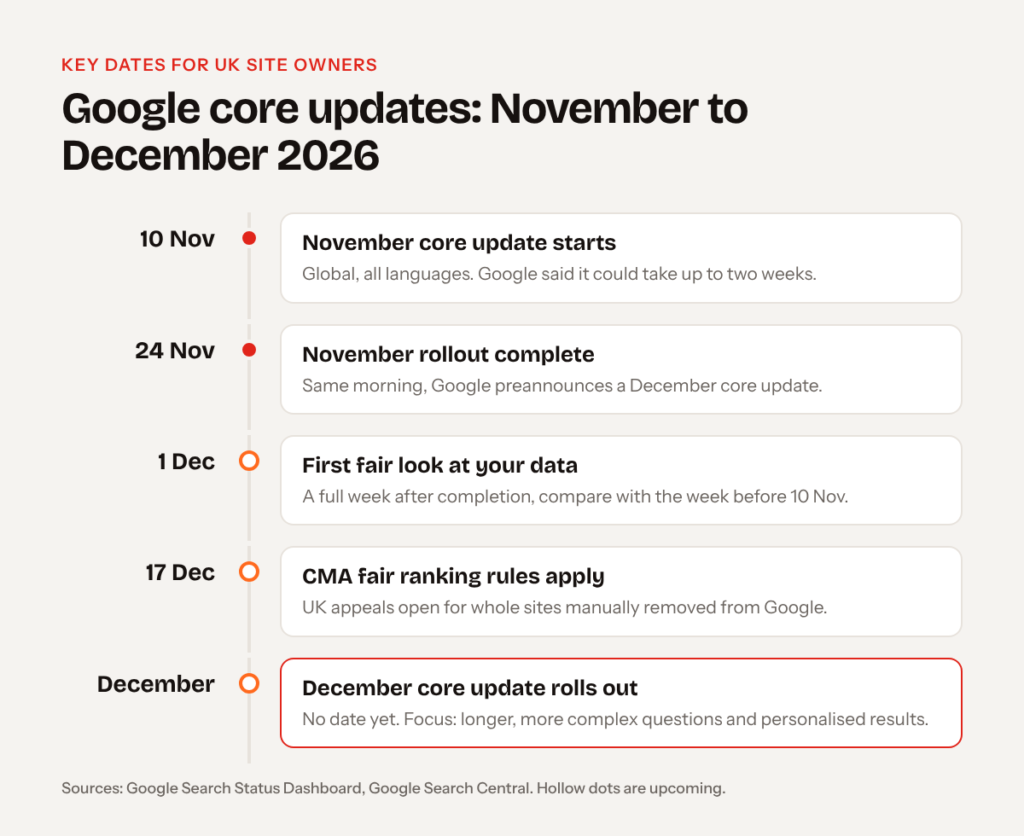
According to the Google Search Status Dashboard, the November 2026 core update started on 10 November, applied worldwide and in all languages, and was marked complete on 24 November. That is the full two weeks Google said it might take.
The timing was awkward for anyone selling online. The rollout ran right up to Black Friday week, so some shops will have seen rankings move just as their busiest trading period began. If that sounds familiar, our Black Friday and Christmas website readiness guide covers the other things worth checking this month.
A December core update is already announced
On the same morning, Google posted a separate preannouncement for the December 2026 core update. It has not started yet. Google says it is scheduled for December 2026 but has not given a date.
Google describes it as several improvements to how its systems understand and rank relevant content, including for longer and more complex questions. It also mentions better personalised results for people who have personalisation switched on. Like November, it will apply to every country and language.
In plain terms: people increasingly type full questions into Google, such as “who can fit a combi boiler in Woking this week and roughly what does it cost”, rather than two or three words. Pages that answer those real questions clearly are more likely to benefit than pages built around a single keyword.
Why Google is warning people in advance now
Core updates used to arrive with little or no warning. That is changing. On 24 November Google added a new ranking section to its Search Central documentation, covering how it ranks results, how it announces changes and how site owners can give feedback.
The stay-informed page says Google will publish advance notice of significant ranking updates (such as core updates) and actionable policy changes on the Search Status Dashboard. For changes that may significantly shift rankings for UK users, Google says it does this in line with the Competition and Markets Authority’s fair ranking conduct requirements.
So this is partly a UK story. The CMA is the UK competition regulator, and its fair ranking rules for Google come into force on 17 December 2026, as Search Engine Journal reported. Under them, Google has to give notice before changes that could noticeably move UK rankings. For small businesses, the practical benefit is simple: you get time to prepare instead of finding out from a sudden drop in phone calls.
A new way to give Google feedback
Google also published a page on submitting feedback about ranking changes. Verified owners of a site in Google Search Console can use the Submit Feedback button after an announced update, adding a hashtag such as #NovemberCoreUpdate2026 so it is grouped correctly. Google suggests including specific searches, example pages and before and after data, and you can say how the change affected a UK market you work in.
Be realistic about what this does. Google says its engineers review feedback in aggregate to spot wider problems, and it will not lead to manual ranking changes for individual pages. It is worth doing if something looks plainly wrong, but it is not a fix.
The same page says that from 17 December 2026, sites serving UK users that have been manually removed from Google’s index entirely will have a new UK appeal route. Very few small businesses will ever need it, but it is good to know it exists.
Has the November update affected your site?
Google’s own guidance on core updates is sensible and worth following. The short version:
- Wait for the data to settle. Google advises waiting at least a full week after an update completes before drawing conclusions. With completion on 24 November, that means looking from 1 December onwards.
- Compare like with like. In Google Search Console, compare the week after completion with the week before the rollout began (3 to 9 November). Seasonal swings around Black Friday can muddy this, so compare with the same period last year too if you have it.
- Do not overreact to small moves. Google says a drop of a position or two does not need drastic action. Bigger, sustained drops across important pages deserve a proper look.
- Look at whole pages, not single keywords. Check which of your pages lost the most clicks. For most small businesses that will be service pages, location pages or category pages.
Google also says recovery can take time. Some improvements show within days, but it can take several months, and sometimes the next core update, before changes are fully reflected. With another update due in December, there is a real chance for pages that slipped in November to recover if they are genuinely improved.
What you should do
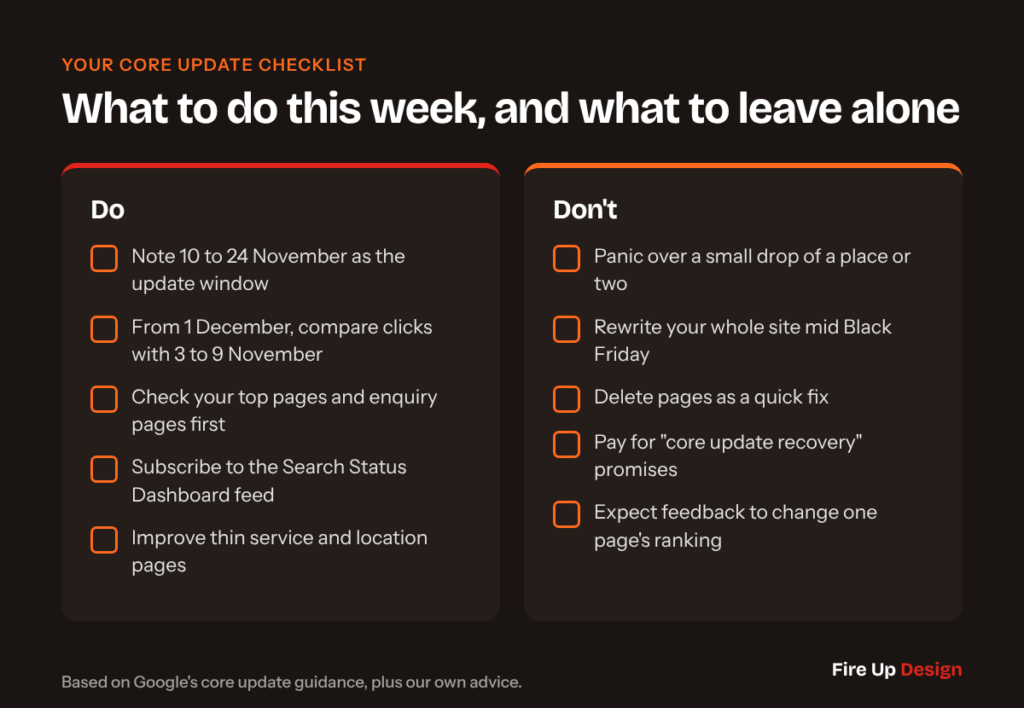
- Mark the dates. Add a note in Search Console (or wherever you track results) for 10 to 24 November, so you do not later blame a dip on something else.
- Check your numbers from 1 December. Focus on the pages that bring in enquiries or sales, not overall traffic.
- Get notified of the next one. The Search Status Dashboard has an RSS feed, and Google now posts preannouncements there first. If you use a feed reader or an agency, make sure someone is watching it.
- Improve the pages that matter before December. For each key service, ask: does this page answer the questions a customer actually asks? Prices or price ranges, areas covered, how long things take, what happens next, real examples of your work. Thin pages with a paragraph of generic text are the ones most exposed.
- Answer longer questions in plain English. Given the December focus on longer and more complex searches, a short, honest FAQ on each service page is a low-effort, high-value addition. We covered how AI-driven search is changing local results in Local SEO in 2026.
- Avoid quick fixes. Google specifically warns against them. Deleting pages, stuffing keywords or buying links will not help and can do harm.
- If rankings were already weak before November, the update is probably not the root cause. Our guide on fixing poor rankings when your SEO isn’t working walks through the usual suspects.
FAQ
When will the December 2026 core update start?
Google has not given a date. It says the update is scheduled for December 2026 and will post on the Search Status Dashboard when the rollout begins. If it follows the usual pattern, it could take up to two weeks to roll out.
My traffic dropped in November. Is my site being penalised?
No. A core update is not a penalty. It is Google reassessing which pages best answer each search. A penalty (a “manual action”) would show up as a message in Google Search Console. Falling in a core update means other pages are currently judged more useful, which you can work on.
Should I rush changes through before the December update?
Make sensible improvements to your most important pages, but do not rebuild your site in a panic, especially in the middle of the Christmas trading period. Steady, genuine improvements to content are what Google says it rewards.
Does the CMA ruling mean Google has to explain why my rankings fell?
No. It means Google has to give advance notice of significant ranking changes affecting UK users and provide ways to give feedback and appeal certain decisions. It does not give individual businesses a right to a ranking or a personal explanation.
Is submitting feedback through Search Console worth it?
If you have clear evidence that results got worse for your customers, yes, it takes ten minutes. Just do not expect it to change your own rankings. Google says it uses feedback to spot wider problems, not to adjust individual pages.
Need a second pair of eyes?
If you are not sure whether November’s update hit you, or you want your key pages in better shape before December, we are happy to take a look. We are a small studio in Guildford and we will tell you straight whether anything needs doing. See our SEO services or get in touch.